Bank KYC Update After Name Change in Karnataka
Changed your name and now the bank is asking for a KYC update? That is normal. A name change means your KYC on record no longer matches your ID, so the bank needs to refresh it. Here is what KYC needs, the documents, and the steps.
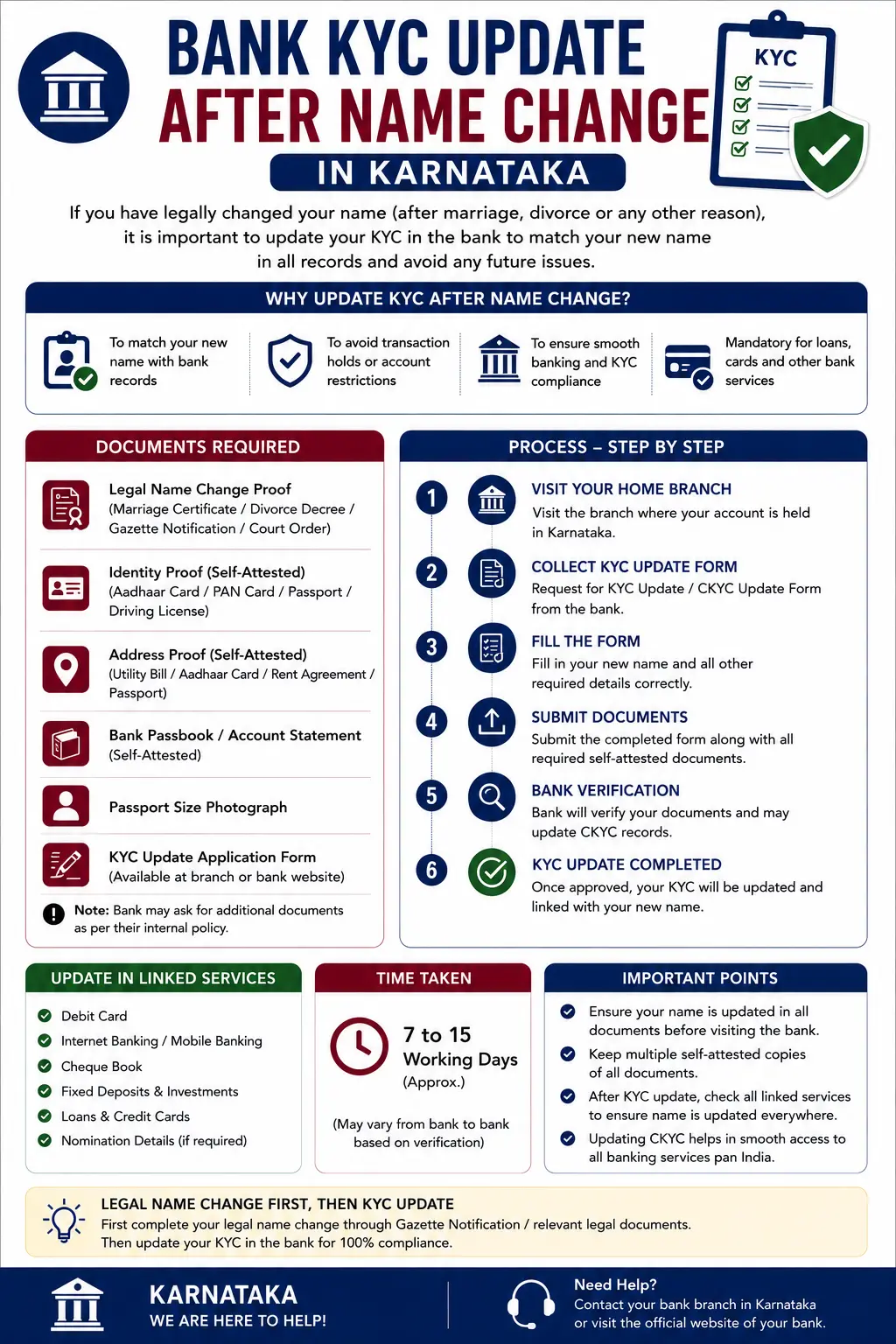
This is the KYC-specific guide. For the full process, see the main bank name change guide.
On this page
- What is KYC and why update it
- Why a name change needs a KYC update
- Nobody will ask you: this is an event trigger
- The central registry nobody mentions
- Documents for the KYC update
- How to update your KYC
- Ask for your KYC Identifier
- What happens if you skip it
- Areas we serve
- People also ask
- Frequently asked questions
What Is KYC and Why Update It
KYC stands for Know Your Customer. It is the identity information your bank holds about you, based on your official documents. Banks are required to keep this accurate and up to date.
When your name changes, your KYC no longer matches your new ID. Updating it keeps your account details correct and avoids any mismatch flags on your account.
Why a Name Change Needs a KYC Update
A name change and a KYC update go together. The name change updates your account name, and the KYC update refreshes the identity record behind it. Both are needed so everything matches.
- Your ID now shows a new name — KYC must reflect it.
- Verification uses KYC — an outdated record can flag your account.
- One submission covers both — the same proof updates name and KYC.
Nobody Will Ask You: This Is an Event Trigger
People assume the bank will get in touch when something needs updating. For a name change that assumption is wrong, and the reason is worth understanding.
- Periodic updates run on a long clock — the cadence is risk based, commonly every two years for high risk customers, eight years for medium risk and ten years for low risk.
- Most people are in the slowest band — so an ordinary salary or savings customer may not be due for a refresh for the best part of a decade.
- A name change is an event triggered update instead — a refresh prompted by something happening, rather than by the calendar reaching a date.
- Which means you have to raise it — the bank has no way of knowing your name changed until you tell them.
- The framework behind it — these obligations sit under the Prevention of Money Laundering Act, 2002 and its record keeping rules, applied through the Reserve Bank's directions on customer identification.
- Low risk customers had an extended window — a relaxation ran to the middle of 2026, so anyone who deferred a periodic update on that basis should check where they now stand.
The Central Registry Nobody Mentions
Your identity record is not held only by your bank. There is a central registry behind the whole system, and understanding it explains why a name can keep reappearing in its old form.
- A central registry holds your KYC record — and assigns you a unique KYC Identifier, a number or code that stands for your verified identity data.
- Other regulated entities can pull it — with your consent, a bank, insurer or other entity can download your existing record rather than asking for the same documents again.
- Which is why the update has to reach the registry — when KYC information is updated or amended, the record has to be re-uploaded so the registry reflects the current position.
- And why an old name can resurface — if the central record still shows the previous name, an institution pulling it will see the old version even though your bank has corrected its own file.
- Consent is required both ways — to fetch your record and to upload it, so nothing moves without your agreement.
- So ask the question at the counter — whether the update will be pushed to the central registry as well as the bank's own records.
Documents for the KYC Update
- KYC update form — provided by your bank.
- Proof of name change — marriage certificate or gazette.
- Updated Aadhaar — showing your new name.
- Updated PAN — showing your new name.
- Recent photo and signature — if the form asks.
How to Update Your KYC
Collect the KYC form
Get the KYC update form from your branch or bank.
Attach your proof
Add the certificate or gazette, plus updated Aadhaar and PAN.
Fill in the new details
Enter your new name and confirm your account information.
Submit at your branch
Hand it in with your request letter and keep the acknowledgement.
Confirmation
Once processed, your name and KYC are updated across your account.
Ask For Your KYC Identifier
Most people have never heard of this and never ask for it. It is the single most useful thing to take away from a KYC update visit.
- It is a number assigned to you — standing for your verified identity record in the central registry.
- It is not only for opening accounts — the Reserve Bank's own guidance confirms it can be used for updating and periodically updating KYC, and for verifying identity.
- So it works at the next counter too — quoting it with your consent lets another entity pull the corrected record instead of asking for the full document set again.
- Ask for it in writing — and note it somewhere safe alongside your other reference numbers.
- Check the name on it — if the registry still carries the old name after your update, that is the thing to chase rather than the branch file.
- Older records may be incomplete — some carry only the fields collected at the time, so an entity may still ask for a mobile number or email to fill gaps.
What Happens If You Skip It
Leaving your KYC outdated after a name change can cause problems later, so it is best to update it promptly:
Why it matters
- A name mismatch can flag your account.
- New cheque books or cards may still show the old name.
- Verifications elsewhere may fail on the mismatch.
What Other Pages Leave Out
These are the gaps we found on pages covering a bank KYC update after a name change.
- Missing everywhere: no page mentions the central KYC registry, or that your record has to be re-uploaded to it when your details are amended.
- Missing: no page tells you to ask for your KYC Identifier, even though it can be used for updating KYC and verifying identity at other entities.
- Missing: no page explains that periodic updates run on a long risk based cycle, commonly two, eight or ten years, so nobody will prompt you about a name change.
- Missing: no page explains why an old name can resurface at another institution, which is the central record rather than your branch being wrong.
- Vague: pages that say a mismatch "can cause problems". Right: the obligations sit under anti money laundering law, which is why identity records are checked rather than assumed.
- Missing: no page notes that consent is required both to fetch and to upload a central record, so nothing moves without you agreeing to it.
Banking regulations, timelines and bank practice change. Confirm current requirements with your own bank or on rbi.org.in before you act. This page is general information and not financial or legal advice.
Bank KYC Update Help Across Karnataka
We help update bank KYC after a name change in every district of Karnataka:
Do not see your city? We serve all Karnataka districts. Just contact us.
People Also Ask About Bank KYC After a Name Change
These are the follow-up questions Karnataka account holders search most, answered in one or two lines each.
Will my bank tell me to update KYC after a name change?
What is a KYC Identifier?
Why does another bank still show my old name?
What should I ask at the counter?
Is my consent needed for the central record?
What documents do I need?
Why do banks insist on this at all?
What happens if I never update it?
Can this be done without visiting a branch?
Which do I update first, Aadhaar or the bank?
Frequently Asked Questions
Do I need a KYC update after a bank name change?
What documents does the KYC update need?
Can I do the name change and KYC update together?
What if I skip the KYC update?
Should I update Aadhaar and PAN before the KYC?
Can you handle the KYC update for me?
People also search for: bank KYC update name change, KYC update after marriage, update KYC bank name, KYC form name change, re-KYC name change, bank KYC documents name change.
Need Your Bank KYC Updated After a Name Change?
Tell us your bank and reason. We prepare the request and KYC form, arrange a gazette if needed, and make sure your Aadhaar and PAN match, so your KYC and name are updated together.
People Also Search For
Related searches that come up alongside a bank KYC update, each answered in a line so you know whether it applies to you.
- CKYC number check online — the KYC Identifier standing for your record in the central registry, which your bank can tell you.
- Re-KYC meaning — a refresh of your KYC record, either on the periodic cycle or triggered by an event such as a name change.
- KYC update frequency banks — risk based, commonly every two years for high risk, eight for medium and ten for low risk customers.
- Account frozen for KYC — usually a pending periodic update rather than a name change, resolved once the refresh is completed.
- RBI KYC Master Direction — the Reserve Bank's directions on customer identification, sitting under anti money laundering law.
- Video KYC bank — a video based verification option many banks offer in place of a branch visit.
- Bank name change application letter — the exact wording. See our application letter format guide.
- Bank account name change process — the full picture. See our bank name change guide.
- Aadhaar name change Karnataka — the record the bank verifies against. See our Aadhaar name change guide.
- PAN card name change — the other identity document. See our PAN name change guide.
- Gazette notification for name change — where a certificate does not prove it. See our gazette name change guide.