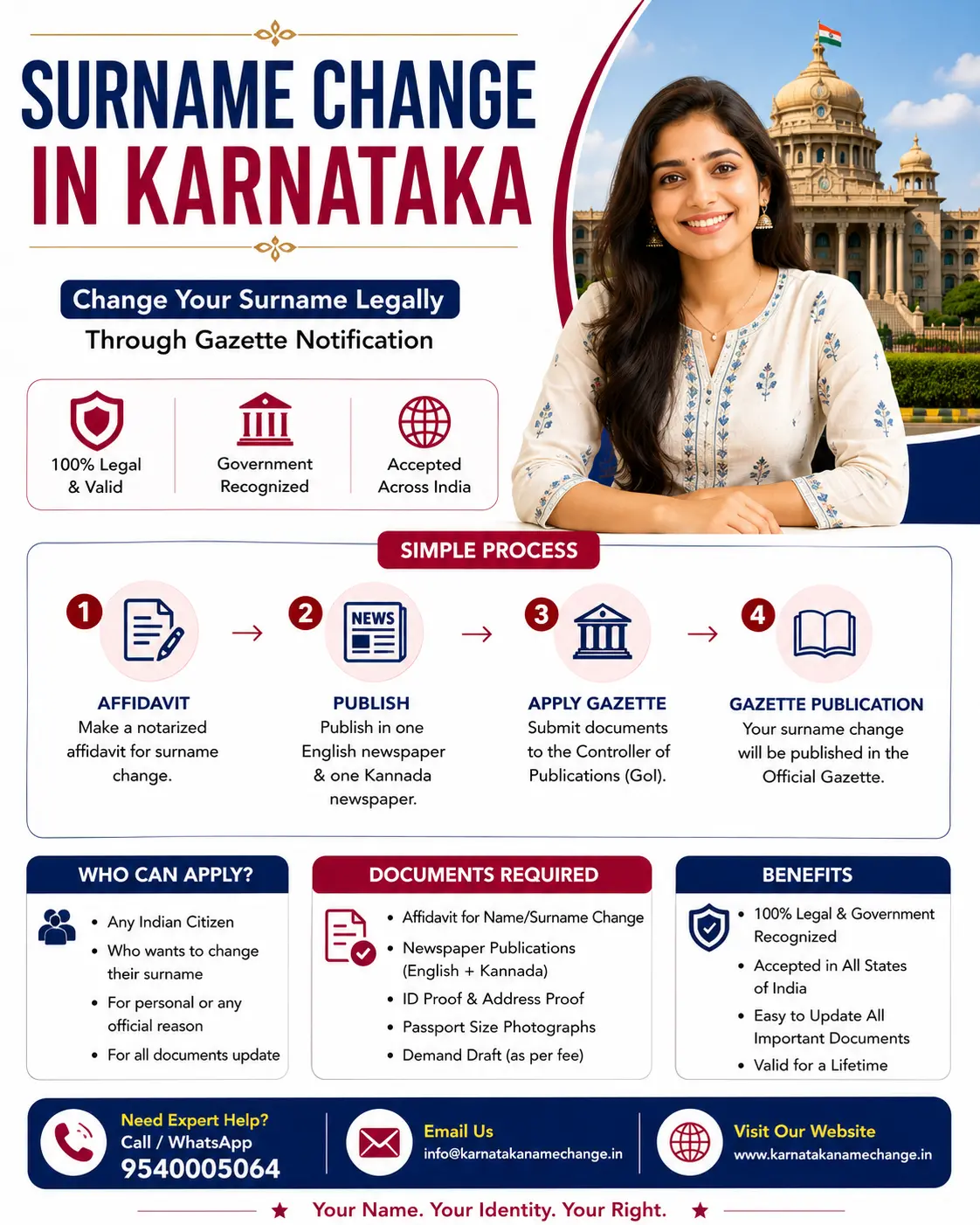
Whether you took your spouse's surname, went back to your maiden name after divorce, or simply dropped a surname you no longer want, we publish it in the Karnataka State Gazette so every ID accepts your new name.
To change your surname in Karnataka, sign a notarized affidavit stating your old and new surname and the reason, publish a notice in one English and one Kannada newspaper, then apply to the Karnataka State Gazette (run by the Department of Printing, Stationery and Publications in Bengaluru). Once published, the gazette becomes your legal proof to update Aadhaar, PAN, passport and bank records.
Here is the point many websites blur: as a Karnataka resident, you can use either gazette. No rule stops you from the Central Gazette. Most people pick the Karnataka State Gazette because it is local and convenient, but the choice is yours, and the three steps are the same for both.
The core steps stay the same, but each reason needs one specific supporting document. Find your case below so you carry the right paper the first time.
You want to take, add or hyphenate your spouse's surname. This is the most common reason, mostly for women.
Extra document: Marriage certificateRegistered under the Hindu Marriage Act or Special Marriage Act.
You want to go back to your maiden surname, or drop your ex-spouse's surname completely.
Extra document: Divorce decreeA certified copy of the family court order.
You want to remove a caste-linked surname and keep only your given name or a chosen surname.
Extra document: None beyond the standard setAffidavit, ID proof and address proof are enough.
Your records carry only a first name, and you want to add a family surname or a parent's surname.
Extra document: Magistrate-attested affidavitOften asked for when the added surname differs from a parent's.
A parent or legal guardian wants to change a child's surname, often after adoption or a family change.
Extra document: Birth certificate plus guardian affidavitFiled by the parent or guardian on the child's behalf.
Your surname is spelled differently across Aadhaar, PAN or your marks card, and you want one correct version everywhere.
Extra document: Copies of the mismatched IDsA small correction may go through the issuing office instead.
Three steps take you from your old surname to a published gazette notification. Skipping or rushing any one of them is the top reason applications get sent back, so we walk each step with you.
Your surname change affidavit is printed on non-judicial stamp paper of Rs 20 or Rs 100. It states your old surname, your new surname, your address, and the reason for the change, then declares that you will be known by the new name from now on. A notary public attests it. For an added surname that differs from a parent's, a first class magistrate may attest it instead.
Tip: the spelling on the affidavit must match your ID exactly. One stray letter here causes rejection later.
Publish a short notice in two newspapers, one English daily such as Deccan Herald or The Times of India, and one Kannada daily such as Prajavani or Vijayavani. The notice carries your old surname, your new surname and the date. Keep the full original pages, since the gazette office asks for physical clippings.
Note: Karnataka does not always insist on the newspaper notice before you apply, but it is strongly advised and often needed for passport updates, so we recommend doing it.
Submit the affidavit, the newspaper clippings, your ID and address proof, photographs and the filled application. For the Karnataka State Gazette, apply online through the e-Rajyapatra portal and pay through Khajane II, or submit in person at the Government Central Press on Mysore Road in Bengaluru. If you choose the Central Gazette of India instead, you file with the Department of Publication in Delhi through the e-Gazette process. After the department verifies everything, your surname change is published, and you download the signed PDF, which is your legal proof.
The published Karnataka PDF should show the Kannada header, a notification number and the issue date. If any of these are missing, download it again from the official portal.
Every applicant carries this common set. Add the one extra document for your reason, listed in the section above.
Costs move a little with your city, your newspaper choice and how urgent your case is. These indicative figures help you budget without surprises.
| Item | Indicative cost | Time it takes |
|---|---|---|
| Stamp paper and notary for the affidavit | Rs 100 to Rs 400 | Same day |
| Newspaper notice (English + Kannada) | Rs 900 to Rs 1,500 together | 1 to 3 days |
| Government gazette publication fee | Rs 1,100 to Rs 1,700, by type of change | Paid at filing |
| Gazette verification and publishing | Included above | 15 to 45 days |
| End to end, if you handle it yourself | Rs 2,500 to Rs 5,000 | 3 to 8 weeks |
Not every surname change forces a gazette. Knowing this saves you time and money, so here is the real picture for the two updates people care about most.
Even when a passport office may accept a marriage certificate on its own, a gazette notification still helps you fix Aadhaar, PAN, bank and college records in one clean go. Many people get it done once so every future update is simple.
We draft your affidavit, book both newspaper notices, and file your surname change on the e-Rajyapatra portal. You stay home, we handle the paperwork, and you get the signed gazette PDF.
Three steps to the gazette, then the order in which everything else falls into line. Save this before you start.
We list “dropping a caste-based surname” as a reason, and then most guides move on. That leaves the question people in this situation actually came to ask.
The practical step people miss. If you hold a caste certificate and you change your surname, get the name on the certificate updated too, using the gazette as proof. Otherwise the certificate reads one name and your other documents read another, and that mismatch surfaces at admissions and recruitment — the two moments it is most expensive. The change is administrative; the caste entry itself is untouched.
A word of caution in the other direction: altering a caste entry, as opposed to a name, is a different matter altogether and is treated as fraud. Nothing on this page is a route to that, and we do not take that work.
The list of records to update is easy to find. The order is not, and getting it wrong is what turns a three-week job into a three-month one.
| Order | What | Why this position |
|---|---|---|
| 1 | Gazette notification | Everything downstream asks for it. Nothing else can start until it exists. |
| 2 | Aadhaar | Every other office asks for Aadhaar and reads the name on it. An Aadhaar that already agrees with your claim turns each later application into a formality. But read the warning below before you file it. |
| 3 | PAN | Verified against Aadhaar. Doing PAN first, while Aadhaar still carries the old surname, is how PAN applications get rejected. |
| 4 | Bank accounts | Banks want Aadhaar and PAN agreeing with each other. Once they do, this is a counter visit. |
| 5 | Passport | Re-issue, with the gazette or the marriage certificate. Existing visas stay in the old booklet, so time this around travel. |
| 6 | Everything else | Voter ID, driving licence, property records, insurance, employer and provident fund. None of these gates the others. |
Read this before you touch Aadhaar. UIDAI allows a name change on Aadhaar only twice in a lifetime. Not twice a year — twice, ever. A surname change after marriage spends one of them. If you later divorce and revert to your maiden surname, that is the second and last. Beyond that you are into an exception route through a UIDAI Regional Office, which is slow and not guaranteed.
So decide the final spelling before you file: hyphenated or not, initials expanded or not, middle name kept or dropped. Filing twice to fix a decision you had not made is the single most expensive mistake on this page, and it cannot be undone.
Some records are reissued. Some are amended. Some are neither, and knowing which is which saves a wasted trip to a university office.
What actually solves this. Keep the gazette PDF and, where you can get one, the issuing body’s linking letter. Together they let any employer or foreign university satisfy itself that the person on the degree and the person on the passport are one. That is what verification teams are looking for — a documented chain, not a rewritten past.
Fake gazette PDFs are sold. They look convincing, and the person holding one usually finds out at a passport or bank counter, months later, with no money back and no notification.
We file gazettes for a living, so treat this as interested advice — but download your own copy from the official portal whoever files it for you, including us. A notification you fetched yourself is one nobody can have invented.
No. There is no law in India that requires a woman to take her husband’s surname on marriage, and nothing happens to a marriage, a bank account or a passport if she does not.
The reason this matters commercially: we would earn more by implying you must. You do not. What we would actually advise is to decide once, with the whole sequence above in mind, and then do it properly — because it is the half-finished change, with Aadhaar in one name and the bank in another, that causes every problem people blame the process for.
The gazette notification is your master proof, but it does not change your other records on its own. Use it to update each of these, and your new surname is consistent everywhere.
An example many families face: after marriage, a Bengaluru resident finds her passport shows her maiden surname while her bank shows her married surname. One gazette notification lets her line up both, plus Aadhaar and PAN, without a separate affidavit for each office.
For a full surname change by choice, yes. The gazette is your legal proof and most offices ask for it. For a surname change after marriage or divorce backed by a certificate or decree, some updates such as the passport may accept that document without a gazette.
Yes. Karnataka publishes the Karnataka Rajya Patra through the Department of Printing, Stationery and Publications in Bengaluru. You can also choose the Central Gazette of India if you prefer. Both are valid across the country.
Yes, there is no restriction. Any Karnataka resident can publish a surname change in the Central Gazette of India from Delhi. It is mandatory only for Central Government employees, who use a deed based process. Everyone else can pick either gazette, and the three steps stay the same.
The affidavit is same day, the newspaper notice takes 1 to 3 days, and the gazette usually publishes within 15 to 45 days after verification. End to end, most cases finish in 3 to 8 weeks.
Expect roughly Rs 2,500 to Rs 5,000 all in if you handle it yourself. That covers stamp paper and notary, two newspaper notices, and the government publication fee of about Rs 1,100 for a major change.
Yes. Many people, mostly women, take, add or hyphenate a spouse's surname. Carry your registered marriage certificate along with the standard affidavit and ID proof.
File the affidavit stating you are restoring your maiden surname, publish the newspaper notice, and apply to the Karnataka Gazette with a certified copy of your divorce decree.
Yes. You can remove a caste-linked surname and keep only your given name or a new surname. The standard affidavit, ID proof and address proof are enough, and the change is published in the gazette like any other.
One English daily such as Deccan Herald, The Times of India or The Hindu, and one Kannada daily such as Prajavani, Vijayavani or Kannada Prabha. Publish both and keep the original printed pages.
Yes. The state runs the e-Rajyapatra portal where you upload your affidavit, newspaper clippings and ID proof, and pay the fee through Khajane II. You can also apply in person at the Government Central Press on Mysore Road.
The Department of Printing, Stationery and Publications runs the Government Central Press on Mysore Road, Bengaluru 560059. Surname change notifications are filed and published there.
Yes. A Karnataka State Gazette notification is valid across India. Banks, the passport office and UIDAI accept it as proof no matter which state you move to later.
Yes. A parent or legal guardian files on the child's behalf, with the child's birth certificate and a guardian affidavit alongside the usual documents.
No. The process is administrative, not a court case, so you can do it yourself. A service simply saves you the trips, gets the paperwork right the first time, and books the newspaper notices for you.
No. Once published, your surname change is a permanent public record. Keep a backup of the PDF in two places, since it is the document offices ask to see.
A gazette notification fixes one correct surname you can carry to every office. For a very small correction, the issuing department may amend the record directly, so ask us and we will tell you the cheaper route.
Yes. A single affidavit and one gazette notification can cover a change to your first name and your surname at the same time, as long as both are stated clearly.
These are the second-round questions — the ones that decide whether the change goes smoothly or takes three attempts.
No. Caste follows birth and is evidenced by your caste certificate, not by your surname. Dropping a caste-linked surname does not alter the certificate, and it does not affect SC, ST or OBC entitlement, which runs on the certificate. What you should do is get the name on the certificate updated, so it does not disagree with your other records at an admission or a recruitment.
Twice in a lifetime. Not twice a year — twice, ever. A surname change after marriage spends one. Reverting to a maiden surname after a divorce spends the second. Past that you are into a slow exception route through a UIDAI Regional Office. Decide the final spelling before you file the first one.
Usually not. A degree records the name at the time it was conferred, and most universities decline to reprint it. What many will issue is a name-change endorsement or a letter linking both names. Ask for that specifically. Together with the gazette it satisfies employers and foreign universities, which is what the requirement is really for.
No. No Indian law requires it. Nothing happens to the marriage, the bank account or the passport if you keep your own surname. It is a choice, and the paperwork cost of making it is real — every ID, every account, and one of your two lifetime Aadhaar changes.
Download it yourself from the official portal. That is the whole test. A real notification carries a notification number and issue date, the Kannada header and Part details on a Karnataka copy, and a digital signature a PDF reader can validate. If all you are handed is a printout or a photograph, treat it as unproven.
No. A published gazette is a public record and a free download. A “retrieval fee” to hand you your own notification is not a government charge. Filing fees and service fees are legitimate; a fee to release your published notification is not.
Yes, and the affidavit should say exactly how you want it written. Be aware that some systems handle hyphens and spaces badly and may store it differently, so check how it comes out on the first document you update and keep every later one consistent with that.
Passports keep surname and given name in separate fields, and getting them the wrong way round causes trouble at immigration and with visa applications that must match. Decide which part of your name is the surname, state it that way in the affidavit, and keep it identical on every subsequent form.
You can, but each change is its own gazette, its own newspaper notice and its own round of updates — and on Aadhaar, its own use of one of your two lifetime changes. If you know both are coming, do them in a single affidavit and a single notification.
They survive the name change; the name on them does not update by itself. Insurance in particular is worth doing properly, since a policy and a nomination naming you under a surname you no longer use is precisely the argument a family does not want to be having later.
It is a bad idea. A name change mid-application means the documents you filed no longer match the ones you hold. Finish one process, then start the other. If it has already happened, tell the passport office rather than hoping the mismatch goes unnoticed.
Indefinitely. Once published it is a permanent public record and does not expire, need renewing or lapse if unused. Keep the PDF backed up in two places, because it is the document offices ask to see years later.
No. A name change in India is an administrative process, not a court case. An affidavit, a newspaper notice and a gazette notification are what it takes. A court comes into it only in unusual situations, such as a contested change to a child’s surname.
Yes. A state gazette notification is valid across India, and banks, UIDAI and the passport office accept it wherever you are. You do not republish it in your new state.
The searches people run just before and just after this one, each with the short answer rather than a link to go and find it.
Non-judicial stamp paper of Rs 20 or Rs 100, stating your old surname, your new surname, your address and the reason, with a declaration that you will be known by the new name. Notarised. The spelling must match your ID letter for letter.
Commonly quoted between Rs 1,100 and Rs 1,700 depending on the type of change, on top of stamp paper, notary and two newspaper notices. Published figures vary; the challan generated at filing is the number that binds.
The Karnataka gazette portal, with fees paid through Khajane II. In-person filing at the Government Central Press on Mysore Road, Bengaluru remains available.
Either works for a Karnataka resident. The Central Gazette is mandatory only for Central Government employees, who follow a deed-based route through their department.
Often no gazette at all — a registered marriage certificate is accepted for a spouse’s surname on re-issue. The gazette still helps if you want Aadhaar, PAN and bank aligned in one pass.
The affidavit states that you are restoring your maiden surname, with a certified copy of the decree. For the passport the decree is often enough on its own.
The name on the certificate is updated with the gazette as proof. The caste entry itself is not touched and is not affected by a surname change.
Two in a lifetime. This single fact should shape the order in which you do everything else.
Roughly Rs 900 to Rs 1,500 for an English and a Kannada daily together. Keep the full printed pages — e-paper links are often refused.
Search the official portal yourself using the notification number. If your notification cannot be found there weeks after publication, that is the answer.
Filed by a parent or guardian, with the child’s birth certificate and a guardian affidavit. A contested change between parents is the one situation here that does go to court.
No law requires it. Both choices are ordinary, and the cost of changing is the paperwork — including one of two lifetime Aadhaar changes.
On the government fee. Published figures for the Karnataka gazette publication fee disagree with one another — we found Rs 400 to Rs 600, Rs 600 to Rs 1,100, and Rs 1,100 to Rs 1,700 quoted by different sources, the last varying with the type of change. We quote the range and say plainly that the challan generated for your application through Khajane II is the figure that binds. Anyone quoting you a single exact number for every case is guessing.
Last checked on 15 August 2026. Fees and portal behaviour change without notice. Where a figure decides something for you, confirm it before you act — and tell us if you find one of these has moved.
Specific surname situations, each explained in full, from single names to passport surnames.
Drop your surname or use a single name, and handle forms and the passport that expect a surname.
Read the guideRemove surname or single name in Karnataka
Fix a surname spelling that differs across your Aadhaar, PAN and certificates, and settle on one correct version.
Read the guideSurname spelling correction in Karnataka
Take, add or keep your surname after marriage, with the marriage certificate as the key document.
Read the guideWife surname change after marriage in Karnataka
Go back to your maiden surname after divorce, and whether the divorce decree is needed.
Read the guideRevert to maiden surname after divorce in Karnataka
Fix a blank, misspelled or spouse surname on your passport, with the State and Central Gazette options.
Read the guideSurname change for passport in Karnataka
A surname change in Karnataka comes down to three careful steps: a clean affidavit, two newspaper notices, and a filing with the Karnataka State Gazette. Get the spelling consistent, carry the one extra document your reason needs, and publish it in the right gazette, and your new surname holds up at every bank, passport office and government counter in the country.
We have handled surname changes for marriages, divorces, caste-name drops and family corrections across Bengaluru and the rest of Karnataka. Tell us your case, and we take it from the affidavit to the signed gazette PDF, then guide you through updating your other records.
Send us your current ID and the surname you want. We reply with your exact document list and a fixed quote, no guesswork.